

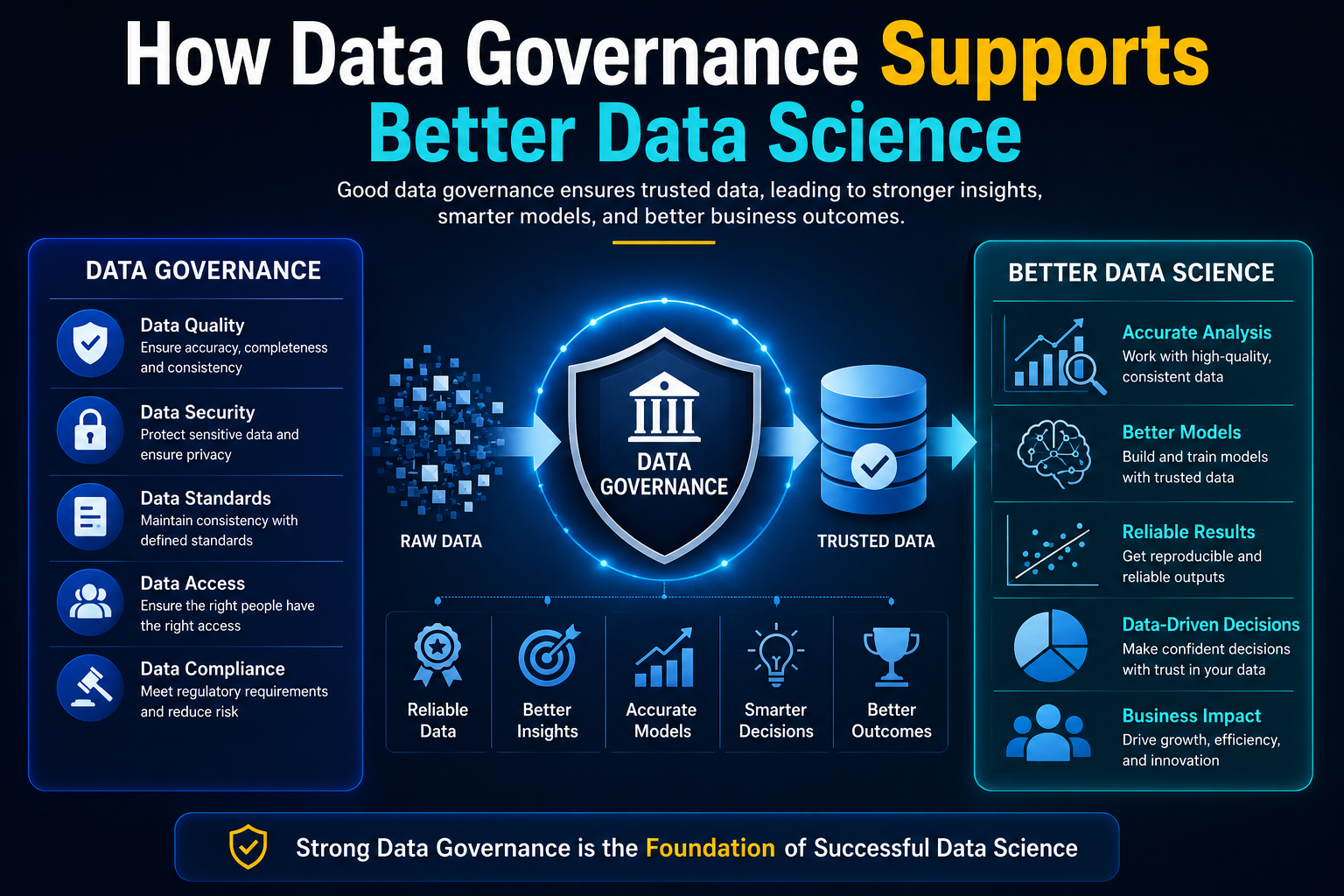
Data science is only as powerful as the data behind it. A team of brilliant analysts armed with cutting-edge machine learning tools can still produce flawed, misleading, or legally problematic results if the underlying data is poorly managed. This is where data governance enters the picture — not as a bureaucratic obstacle, but as the structural foundation that makes data science trustworthy, scalable, and effective.
Data governance refers to the policies, processes, standards, and roles that define how data is collected, stored, accessed, and used across an organization. When done well, it creates a controlled environment in which data scientists can move faster, trust their inputs, and deliver results that actually hold up to scrutiny.
What Is Data Governance, Really?
At its core, data governance is about accountability and clarity. It answers questions like: Who owns this dataset? Who is allowed to access it? How was it collected, and has it been cleaned? What does this field actually mean? Without answers to these questions, data science becomes a guessing game.
A mature data governance framework typically includes a data catalog (a searchable inventory of available datasets), defined data stewards or owners responsible for specific data domains, data quality standards and validation procedures, access control policies that determine who can see what, lineage tracking that shows where data came from and how it has been transformed, and compliance rules aligned with regulations such as GDPR, HIPAA, or CCPA.
None of these components are glamorous. But collectively, they eliminate the kind of ambiguity that slows data science teams down and undermines confidence in their findings.
The Hidden Cost of Poor Governance
Before exploring how governance helps, it’s worth understanding what happens without it. Organizations that skip governance frameworks often find their data science initiatives stalled or ineffective — not due to lack of talent or technology, but due to invisible structural problems.
Data scientists in ungoverned environments routinely spend 50 to 80 percent of their time on data wrangling: finding the right data, cleaning it, reconciling conflicting definitions, and verifying that what they have is actually usable. This is time that could be spent on modeling, analysis, and deriving insights.
Beyond productivity, poor governance creates reliability risks. When multiple teams maintain their own versions of customer records, product catalogs, or transaction logs with no central standard, models trained on one version perform inconsistently when deployed against another. A churn prediction model trained on marketing’s definition of an “active customer” may behave completely differently when scoring against data shaped by finance’s definition. These inconsistencies erode trust in data science outputs — often silently, making them harder to diagnose.
There is also a growing compliance dimension. Regulations around data privacy require organizations to know exactly what personal data they hold, where it lives, and how it is being used. Data science workflows that pull together data from multiple sources without proper governance can unknowingly violate these requirements, creating significant legal and reputational exposure.
How Governance Accelerates Data Science
1. Faster Data Discovery
One of the most immediate benefits of good governance is discoverability. A well-maintained data catalog gives data scientists a single place to search for available datasets, understand their structure, see metadata and documentation, and identify who to contact for access. Instead of emailing colleagues or digging through shared drives, a data scientist can find a relevant dataset in minutes rather than days.
This is not a minor convenience. In fast-moving business environments, the ability to quickly identify the right data for a new analysis or model is a genuine competitive advantage.
2. Higher-Quality Training Data
Machine learning models learn from data. If that data is incomplete, inconsistently formatted, or riddled with errors, the models inherit those flaws. Data governance establishes quality standards — rules about acceptable ranges, required fields, duplicate detection, and anomaly flags — that are enforced before data reaches the modeling stage.
When data quality is governed systematically, data scientists spend less time on remediation and more time on feature engineering, model selection, and interpretation. They can also trust that the quality standards they relied on when training a model will continue to be enforced in production, reducing model drift caused by upstream data degradation.
3. Consistent Definitions Across Teams
One of the most underappreciated governance contributions is the enforcement of shared data definitions. What counts as a “sale”? Is a trial user a “customer”? How is “revenue” defined — by contract date, invoice date, or payment receipt? These semantic questions, left unanswered, cause different teams to reach contradictory conclusions from the same underlying data.
Data governance creates a business glossary — a shared vocabulary that ties technical data fields to agreed-upon business definitions. When a data scientist builds a dashboard showing monthly revenue, everyone looking at that dashboard is reading the same thing. This consistency is the difference between an organization that argues about numbers and one that acts on them.
4. Responsible Access Without Bottlenecks
Data scientists need access to data, but not all data should be accessible to everyone. Sensitive personal information, financial records, and proprietary business data require protection. Without governance, organizations often resolve this tension in one of two unhealthy ways: they lock everything down (creating bottlenecks and frustrating data teams) or they open everything up (creating risk).
Good governance establishes role-based access control — a structured system where data scientists can request and receive access to the data they need, with appropriate controls in place. Automated approval workflows, audit logs, and data masking capabilities allow teams to work efficiently while maintaining security. The result is faster access to the right data with full traceability of who used what and when.
5. Reproducibility and Auditability
Science requires reproducibility. When a data science team delivers a model or analysis, stakeholders — from business leaders to regulators — may later ask: How did you get this result? What data was used? Were there any transformations applied?
Data lineage tracking, a core governance capability, makes these questions answerable. It records the journey of data from its source through every transformation, join, and enrichment step to its final form in an analysis or model. This lineage documentation is invaluable for debugging unexpected model behavior, auditing algorithmic decisions for bias or compliance, and re-running historical analyses with updated data while maintaining comparability.
Without lineage, reproducing a three-month-old analysis often requires reconstructing every step from memory or scattered notes — an unreliable and expensive process.
6. Ethical AI and Bias Reduction
The societal impact of biased or poorly governed data in machine learning is increasingly well-documented. Models trained on historical data that reflects past discrimination can perpetuate and amplify those patterns. Governance frameworks that include data provenance tracking, demographic auditing capabilities, and bias detection protocols give data science teams the tools to identify and address these issues systematically.
Knowing where training data came from, how it was collected, and which populations it represents is essential for responsible AI development. These are fundamentally governance questions. Organizations that govern their data well are better positioned to build models that are not only accurate but also fair and defensible.
Building a Governance Culture That Supports Data Science
Implementing data governance is not purely a technical exercise — it requires cultural change. Data scientists and governance professionals sometimes have a tense relationship, with scientists viewing governance as slow and bureaucratic and governance teams viewing scientists as cavalier with sensitive data. Bridging this divide requires mutual respect and practical collaboration.
The most effective governance programs embed data scientists in governance conversations from the beginning. Rather than receiving policies as top-down mandates, data teams contribute to defining data quality standards, help design cataloging schemas that reflect how they actually work, and flag governance gaps that their day-to-day work surfaces.
Leadership plays an equally important role. When executives treat data governance as a strategic priority — not just a compliance checkbox — it signals that the organization takes data quality and responsibility seriously. This top-down commitment creates the organizational will to maintain governance standards even when it requires short-term investment or inconvenience.
Governance as a Competitive Advantage
Organizations with mature data governance don’t just avoid problems — they gain advantages. Data science teams embedded in governed environments can move faster because they spend less time searching for and cleaning data. They can deliver more reliable results because their inputs are consistent and well-documented. They can scale their work more effectively because models trained on governed data behave predictably in production.
Ultimately, the question is not whether data governance is worth the effort. It is whether an organization can afford the alternative: data science operating on a foundation of ambiguity, inconsistency, and risk. The answer, for most organizations competing in data-driven markets, is increasingly clear.
Conclusion
Data governance and data science are not competing priorities — they are complementary disciplines that reinforce each other. Governance provides the structure, standards, and trust that data science needs to deliver genuine value. Data science, in turn, stress-tests governance frameworks and reveals where they need to evolve.
Organizations that invest in both — and that build bridges between the teams responsible for each — position themselves to turn data into a durable strategic asset. In an era where data is often called “the new oil,” governance is the refinery that makes it usable.
Visit site: vyvymangatech.com