

Introduction
The world of work is changing faster than ever before. Advances in technology, shifting employee expectations, and global events have reshaped how organizations operate. One of the most significant outcomes of this transformation is the rise of the hybrid work model, where employees split their time between remote and in-office work. As businesses adapt to this new reality, a new workforce is emerging—one that requires a fresh set of skills to thrive.
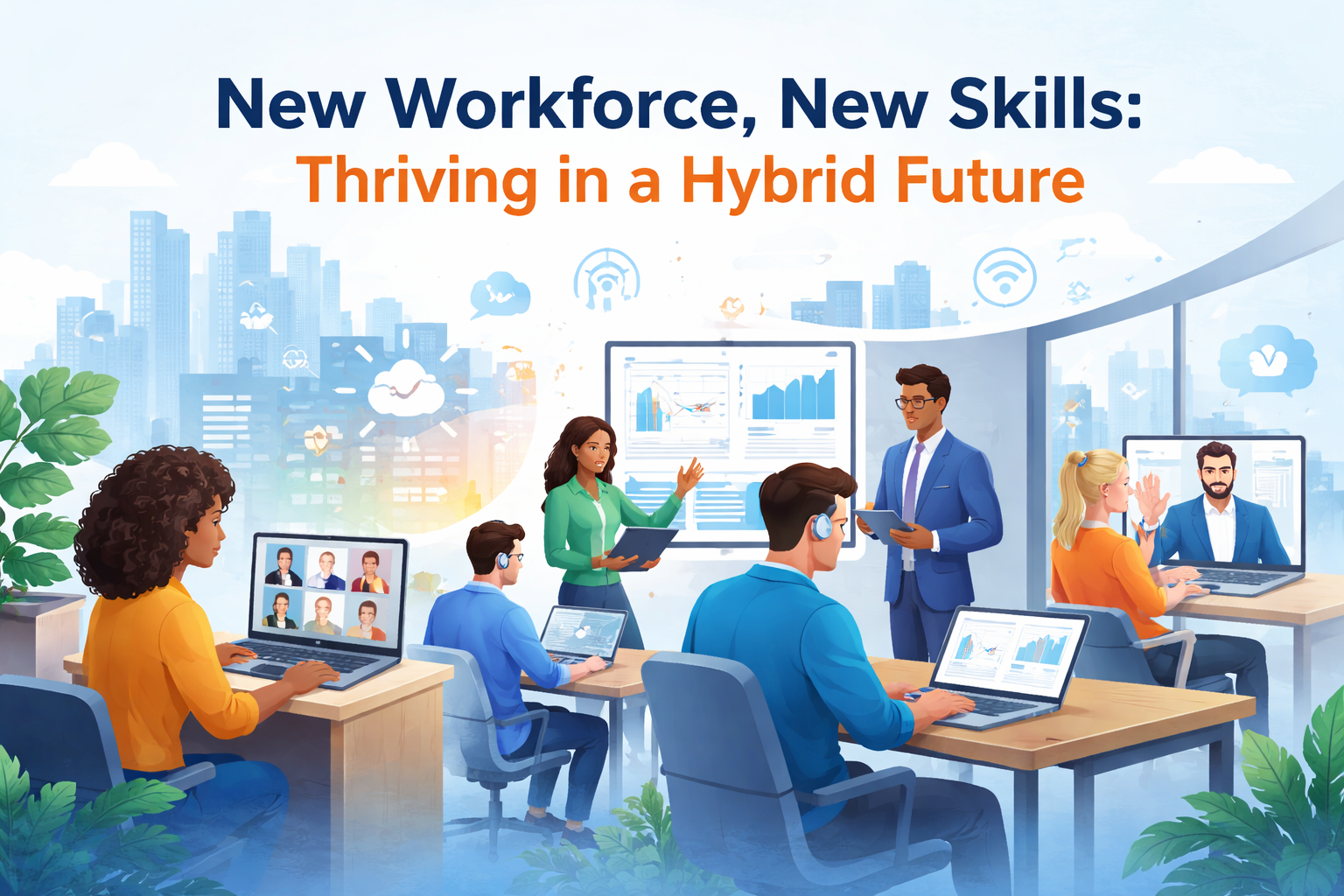
New Workforce, New Skills: Thriving in a Hybrid Future is not just a trend; it is a necessity for long-term success. Employees and organizations alike must rethink how work is done, how teams collaborate, and which skills are essential for productivity, innovation, and growth.
Understanding the Hybrid Work Model
Hybrid work is a people-first approach to managing the workforce that drives increased productivity and job satisfaction while addressing the major challenges of remote work, such as isolation and lack of community. A hybrid work model provides employees with greater flexibility and the option to work from home or anywhere they can be productive. With hybrid work, the workplace is no longer inside the four walls of the corporate office—it’s an ecosystem of employees working from home, in coworking spaces, and the office. Team members can migrate between various locations depending on the work they need to get done.
The hybrid work model can take different forms depending on the organization and the type of work being done.
Key Characteristics of Hybrid Work
- Flexible work locations
- Digital-first communication
- Results-oriented performance measurement
- Greater emphasis on autonomy and trust
This model offers benefits such as improved work-life balance, reduced commuting stress, and access to global talent. However, it also introduces challenges like communication gaps, isolation, and skill mismatches.
The Rise of a New Workforce
This growing sector of workers is part of the “new-collar” workforce—a class of skilled professionals who blend technical know-how with practical, hands-on experience. These are not white-collar or blue-collar jobs. They’re something new.
“New-collar” jobs typically don’t require a four-year degree but demand rigorous training, problem solving, and adaptability. They’re high-impact roles that are essential to America’s competitiveness in the AI age—and they come with real staying power. According to the World Economic Forum Future of Jobs Report 2025, frontline jobs including construction are among the fastest growing in the world, and are expected to remain in demand through 2030 and beyond.
Workforce Shifts Shaping the Future
- Increased participation of remote professionals
- Multigenerational teams with different work styles
- Growth of freelancers and contract-based roles
- Higher demand for digital and soft skills
In this evolving landscape, organizations must align talent strategies with changing workforce expectations.
Why New Skills Are Essential in a Hybrid Future
This week IBM launched a significant study which looks at the real skills business leaders need over the next three years, and the results will surprise you.
The research, which included surveys across 50 countries (5800 executives), found that approximately 120 Million professionals need to be reskilled to deal with AI and new digital business environments, and the biggest gaps are not “digital skills,” but behavioral skills.
I have been talking about this over the last year – this research reinforces the fact that while digital and technical skills are in high demand (41% of CEOs are worried), they can be filled fairly quickly. More than 45% of CHROs tell us people coming out of college have the digital skills they need: what they’re missing is skills in complex problem solving, teamwork, business understanding, and leadership.
Skills Gap in Hybrid Workplaces
The world of work has undergone fundamental changes over the last three years. New ecosystems of digital work have emerged, supported by a suite of platforms that enable teams to collaborate in real-time across the world, from the comfort of their own homes, or wherever they choose to work. Teamwork has officially moved from meeting rooms to Zoom calls.
That isn’t to say that the traditional office is a thing of the past. Many businesses find that face-to-face collaboration still delivers strong results, sparking the concept of hybrid work, conducted partially at home and partially in the office. According to recent statistics,30% ofthe European employed workforce will work recmotely in the next five years – a popular decision amongst employees. According to a recent study by Deloitte,a majority of millennials (62%) and Gen Zers (63%) prefer to work remotely at least some of the time. In comparison, only a small percentage of them (20% and 19%, respectively) are interested in working in an office on a full-time basis.
With a fundamental shift in working culture like this, comes a required shift in team operations and skillsets. Collaborating partially using remote working tools is vastly different from collaborating face-to-face full-time.
However with this fundamental shift in working culture comes a series of challenges, including communicating via digital platforms, building relationships, and collaborating with teams across the globe.
Learnlight’s team of experienced trainers and coaches are experts in developing hybrid work skills and have worked with companies of all sizes across industries to improve team communication and collaboration in virtual and hybrid work models. This extensive experience has allowed us to identify the common communication issues that arise in hybrid work models, and to develop practical solutions that can help teams overcome these challenges – resulting in our new ebook; “Bridging the Communication Skills Gap in the Hybrid Workplace.”
This ebook provides practical solutions for communicating across teams, helping teams to collaborate effectively in a hybrid work environment. Readers of the ebook will develop a clear understanding of the communication skills needed to thrive in today’s hybrid workforce.
Essential Digital Skills for Hybrid Work
The emergence of the hybrid workplace has presented us with exciting opportunities and unique challenges.
As we adapt to hybrid work, certain skills have become essential for achieving individual and collective success. This includes the ability to navigate digital tools effectively, communicate across virtual platforms, maintain productivity and accountability, and cultivate wellbeing.
From articles and videos to webinars and online courses, we have curated a range of learning opportunities to cater to different learning styles and preferences. Take advantage of the resources available!
Check back for new resources that will be added over time.
In-Demand Digital Skills
- Cloud-based collaboration tools
- Video conferencing and virtual presentation skills
- Cybersecurity awareness
- Data literacy and analytics basics
- AI-assisted productivity tools
Organizations should invest in training programs that help employees master these technologies.
Communication Skills in a Hybrid Environment
The shift to hybrid work environments has transformed the way organizations operate, bringing both opportunities and challenges. One of the most significant challenges is maintaining effective communication among team members who are not always physically present in the same location. As a manager, fostering effective communication in a hybrid work environment is crucial to ensure productivity, collaboration, and employee satisfaction. This article explores strategies and best practices that managers can implement to enhance communication in a hybrid setting.
Key Communication Skills
- Written communication clarity
- Active listening in virtual meetings
- Asynchronous communication management
- Cross-cultural communication
Strong communication ensures alignment, reduces misunderstandings, and builds trust across hybrid teams.
Collaboration and Teamwork in Hybrid Teams
Collaboration is the backbone of any successful organization. For remote and hybrid teams, effective collaboration not only drives project success but also enhances innovation and decision-making. A study by Harvard Business Review highlights that teams that communicate frequently and leverage collaborative technologies are more innovative and responsive to market changes.
How to Improve Hybrid Collaboration
- Use shared project management tools
- Set clear goals and responsibilities
- Encourage inclusive participation
- Promote knowledge sharing
Teams that collaborate effectively are more innovative and resilient in a hybrid future.
Leadership Skills for the Hybrid Future
Modern leadership requires a shift from management to coaching.
In 2025, focus on 7 skills:
- Transformational communication & feedback
- High EQ & psychological safety
- Strategic consistency
- Data-driven planning
- Empowering delegation
- Continuous learning (especially with AI)
- A culture of innovation
Manager and leader are terms that don’t necessarily always go hand in hand. While the two are linked, true leadership injects motivation and forward-thinking insight into a role, going a step above traditional management.
In 2025, the challenge has evolved. Leaders must navigate hybrid/remote teams, leverage AI, and adopt a coaching mindset to retain top talent and drive innovation. This requires more than just foundational skills. It demands an updated, future-focused approach.
Here are the essential skills you’ll need to stand out, lead your team, and achieve consistent, long-term success in the new world of work.
Adaptability and Continuous Learning
Adaptability and continuous learning are essential, interconnected skills for navigating a fast-changing professional landscape. By actively acquiring new knowledge and embracing change, individuals and organizations build resilience, foster innovation, and maintain relevance. Key strategies include maintaining a growth mindset, seeking feedback, taking initiative in training, and applying new insights to evolving challenges.
Building a Learning Mindset
- Encourage upskilling and reskilling
- Provide access to online learning platforms
- Support career development plans
- Reward innovation and curiosity
New Workforce, New Skills: Thriving in a Hybrid Future depends heavily on an organization’s ability to foster lifelong learning.
Time Management and Self-Discipline
Time management and self-discipline are essential, interdependent skills that drive productivity and goal achievement by prioritizing tasks, maintaining focus, and overcoming distractions. Effective methods include creating prioritized task lists, setting realistic, clear goals, and using techniques to manage energy and avoid procrastination.
Important Self-Management Skills
- Prioritization and goal setting
- Managing distractions
- Maintaining work-life boundaries
- Accountability and consistency
Employees who manage their time effectively experience less burnout and higher job satisfaction.
The Role of Emotional Intelligence
Emotional Intelligence (EI or EQ) is the ability to identify, understand, and manage your own emotions while recognizing and influencing the emotions of others. It serves as a crucial,, trainable, soft skill for fostering strong relationships, effective communication, stress management, conflict resolution, and leadership success, acting as a counterpart to cognitive intelligence.
Benefits of High Emotional Intelligence
- Better conflict resolution
- Stronger team relationships
- Increased empathy and inclusion
- Improved leadership effectiveness
Hybrid workplaces thrive when emotional intelligence is valued as much as technical expertise.
Diversity, Equity, and Inclusion in Hybrid Work
Diversity, Equity, and Inclusion (DEI) in hybrid work requires intentional, proactive management to avoid proximity bias—favoring in-office employees—and ensure fair treatment for remote workers. While hybrid models offer flexibility that can improve work-life balance and boost employee engagement by 2.4 times, they risk excluding remote staff from career opportunities and decision-making. Success relies on fostering psychological safety, leveraging technology for equitable collaboration, and adopting flexible policies that support diverse needs.
Inclusive Hybrid Practices
- Equal access to opportunities
- Transparent communication
- Bias-free performance evaluations
- Support for diverse working needs
A diverse and inclusive workforce is more innovative and adaptable.
The Role of Organizations in Skill Development
Organizations play a crucial role in skill development by implementing continuous training, fostering mentorship, and adopting skill-based structures to bridge talent gaps, enhance employee satisfaction, and drive innovation. They transform traditional roles into flexible, competency-focused environments, allowing for better talent utilization, increased productivity, and adaptability to market changes.
How Companies Can Help
- Offer structured training programs
- Encourage mentorship and peer learning
- Invest in digital infrastructure
- Align skills training with business goals
Companies that prioritize skill development are better prepared for the future of work.
Measuring Success in a Hybrid Future
A practical guide for HR leaders to measure and improve the business impact of hybrid work using five core metrics.
Table of Contents
Key Hybrid Work Metrics to Measure
Continuous Improvement & Next Steps
A Successful Hybrid Strategy Starts with an Agile Workforce
Need help onboarding, hiring, and paying global teams?
15 min demo
92% of companies now have hybrid programs. This flexibility in how, where, and when employees work presents exciting opportunities for business growth. Perks like better work-life balance (76%) and stronger in-person relationships (55%) are real, according to Gallup’s Indicator.
Modern Performance Indicators
- Productivity and quality of work
- Collaboration effectiveness
- Employee engagement
- Skill growth and adaptability
Clear metrics help organizations optimize hybrid strategies.
Challenges of Hybrid Work and How to Overcome Them
More than four years after the Covid-19 pandemic accelerated an immediate shift to remote knowledge work, it’s clear that, despite some organizations’ attempts to lure employees back to the office full-time, hybrid work arrangements are here to stay. And yet employers are still struggling with implementation. In particular, the managers we have talked to point to three key issues: scheduling, culture, and productivity.
Common Challenges
- Communication breakdowns
- Employee isolation
- Unequal visibility
- Technology fatigue
Practical Solutions
- Regular check-ins and feedback
- Strong onboarding processes
- Clear hybrid policies
- Wellness and mental health support
Addressing these challenges ensures long-term sustainability.
The Future Outlook of Hybrid Work
Hybrid work is not a temporary solution; it is the future of work. As technology continues to evolve, hybrid models will become more refined and efficient.
New Workforce, New Skills: Thriving in a Hybrid Future will remain a central focus for organizations seeking growth, resilience, and innovation.
Conclusion
The shift to hybrid work has transformed the workforce and redefined the skills required for success. Digital fluency, communication, adaptability, leadership, and emotional intelligence are no longer optional—they are essential.
Organizations that invest in people and skills will thrive, while employees who embrace continuous learning will remain competitive in a rapidly changing world. By aligning talent strategies with modern work models, businesses can truly succeed in the hybrid future.