

In today’s data-driven world, the capacity to turn complex data into actionable insights has become crucial for businesses that wish to remain competitive. With the advent of advanced analytics and artificial intelligence (AI), firms are now better equipped to glean valuable insights from vast amounts of data. This blog post will explore methods, tools, and strategies for transforming complex data into actionable insights, referencing the innovative solutions offered by Onyx Data.
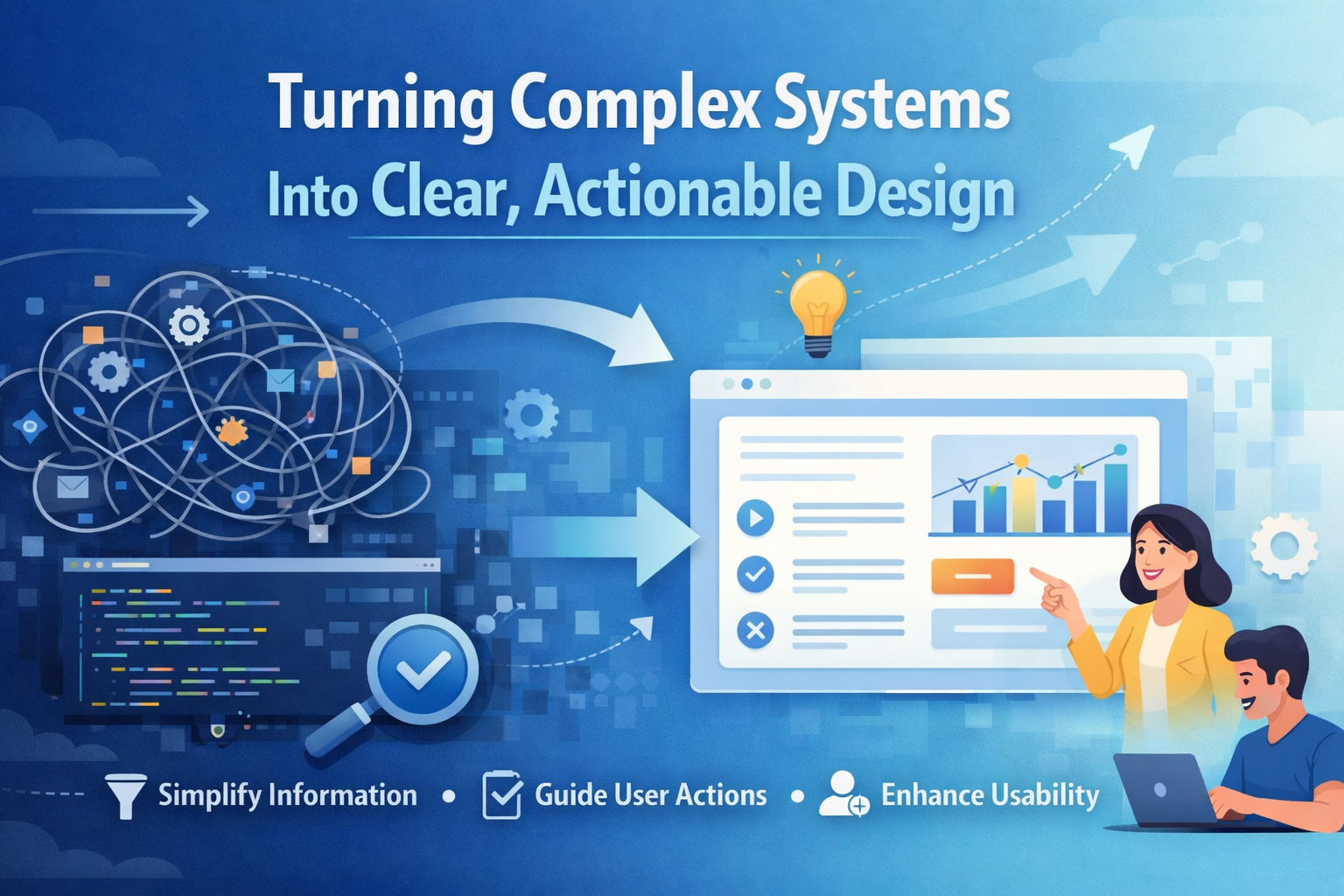
This article explores how designers, product teams, and businesses can transform complicated systems into intuitive, user-friendly experiences that drive clarity, efficiency, and real-world results.
Understanding What Makes Systems Complex
In today’s data-driven world, the capacity to turn complex data into actionable insights has become crucial for businesses that wish to remain competitive. With the advent of advanced analytics and artificial intelligence (AI), firms are now better equipped to glean valuable insights from vast amounts of data. This blog post will explore methods, tools, and strategies for transforming complex data into actionable insights, referencing the innovative solutions offered by Onyx Data.
Multiple User Types and Goals
It seems that most of the time, having only one user model gets the job done when building an app with standard authentication. A User signs up, signs in, can access information like most other Users, and signs out.
But how do you make it work on the rare occasion that your app has more than one type of user? There are several different approaches that you could take to handle this problem-including using gems dedicated to this exact situation. But I am going to show one way that I made it work on an app that I recently built.
Dense Data and Interdependencies
A software program is presumed to have a sequential description written from top to bottom in the program file, namely, it has sequential execution characteristics, and when its multiple instructions are executed concurrently, it will fail to execute the program. Fig. 4.2(a) shows a program fragment consisting of three statements, i.e., addition, multiplication, and finally subtraction. This fragment is used for a description of the relationship between the algorithm and its sequential execution. The program is generally executed from the top line to the bottom line, and the three statements in the program fragment are equivalent to three instructions generated by the compiler, which should be sequentially executed to avoid breaking the algorithm.
Technical Constraints
Technical constraints are limitations in software, hardware, or processes—such as legacy systems, limited API capabilities, or specific programming language requirements—that restrict design choices and development speed. These, along with resource constraints (budget/time) and physical limitations, force architectural trade-offs to prevent project delays or, in some cases, failure to meet user requirements.
Why Clear, Actionable Design Matters
User research is powerful, but only if it actually changes something. It’s all too common for teams to invest time and budget into interviews, usability tests, or surveys, only for the insights to sit in a slide deck that never gets opened again. Great design is about translating that feedback into meaningful improvements. So how do you make sure your insights lead to action?
At Make it Clear, we believe the value of user insights is in what happens next. This post walks through the full process of converting raw user insights into design decisions that are practical, prioritised, and effective.
Improved User Confidence
Users want to feel engaged and confident in site navigation, regardless of experience. Using user experience to build user confidence doesn’t just encourage users to become frequent visitors and customers of the interface, it also gives them the confidence to recommend the system to others.
Faster Decision-Making
Faster decision-making requires setting clear, actionable goals, limiting choices to avoid paralysis, and embracing “good enough” rather than perfection. Techniques include setting strict deadlines, using frameworks like RAPID (Recommend, Agree, Perform, Input, Decide) or SPADE, and trusting your intuition based on experience.
Reduced Support and Training Costs
Reducing support and training costs involves transitioning to digital-first, on-demand, and automated solutions to minimize instructor-led, in-person, and recurring expenses. Key strategies include utilizing AI-driven tools, microlearning, Digital Adoption Platforms (DAPs), and content repurposing to create scalable training and self-service support.
Higher Adoption and Retention
Higher adoption and retention are achieved by ensuring users quickly find value (“Aha! moment”) in a product and integrate it into their daily workflows, reducing churn and increasing lifetime value. Key strategies include personalized onboarding, in-app guidance, and continuous feedback loops to improve feature adoption.
Core Principles of Actionable Design
In reality, there are roughly a dozen basic principles of design that beginning and expert designers alike should keep in mind when working on their projects. In addition, there are another dozen or so “secondary” design principles that are sometimes included as basics (for example, the Gestalt Principles, typography, color, and framing). The main design principles are explained below, with examples—and then summarized in an infographic. (Jump to the downloadable Principles of Design Infographic.)
Throughout my career as a product designer for startups and companies like Airbnb and Colgate, I’ve learned to never stray too far from the fundamental principles of design. My work focuses on making information-dense UI’s easy to understand and navigate, and core design principles guide virtually every creative decision I make. In this article, we’ll explore principles like contrast and unity—and see how mastering them is the key to compelling user experiences.
User-Centered Thinking
User-Centered Thinking (or Design) is an iterative, empathetic framework prioritizing user needs, behaviors, and pain points across every development stage. It boosts usability and satisfaction by using research, prototyping, and testing to create intuitive solutions, rather than forcing users to adapt to technology.
Progressive Disclosure
Progressive disclosure is a user experience (UX) design technique that minimizes complexity by showing only essential information initially, revealing advanced options or details only when needed. It reduces cognitive load, improves usability for both novice and expert users, and prevents users from feeling overwhelmed by too many options. Common patterns include accordions, wizards, mega menus, and “read more” links.
Visual Hierarchy
Visual hierarchy is the strategic arrangement of design elements—such as size, color, contrast, and spacing—to signal importance and guide the viewer’s eye in a specific order. It establishes a clear, logical flow, ensuring critical information is processed first, reducing cognitive overload, and improving user experience.
Consistency
Consistent patterns reduce cognitive load. When users learn how one part of the system works, they should be able to apply that knowledge elsewhere without relearning.
Breaking Down Complexity Into Manageable Pieces
We get it. Complex tasks and projects are hard work. That’s why we tend to avoid and put them off, for as long as humanly possible. And then, when we finally get to it, we end up scrambling at the last minute, only to deliver a total and utter shipwreck.
Modular Design
Modular design is an approach that divides a product or system into independent, standardized units called “modules,” which can be combined, replaced, or interchanged to offer flexibility, scalability, and easier maintenance. This method reduces costs and development time while promoting sustainability through easier repair, reuse, and recycling.
Task-Based Organization
Task-Based Organization structures work around specific, defined tasks rather than just roles or time, prioritizing efficiency, accountability, and clear deliverables. It involves breaking projects into manageable actions to boost productivity, ensure accuracy in routine operations, and improve resource allocation. This model relies on structured workflows, such as to-do lists, project management tools, and goal-oriented planning to reduce stress and maximize output.
Clear Navigation Paths
Improved Usability: Clear navigation paths help users understand how to navigate a system, reducing frustration and confusion. Enhanced User Journeys: Mapping navigation paths allows teams to visualize user journeys, enabling better design decisions that meet user needs.
Turning Information Into Action
Turning information into action requires a structured process of gathering, cleaning, and analyzing data to generate insights that drive specific, measurable business decisions. Key steps include defining clear objectives, using data visualization tools to identify patterns, and implementing actionable strategies like marketing campaigns or operational changes to improve results.
Meaningful Labels and Language
Avoid technical jargon whenever possible. Use plain language that matches how users think and speak. Labels should clearly explain what will happen when clicked.
Smart Defaults
Smart defaults are pre-filled, context-aware settings or form fields that use user data, AI, or behavioral patterns to anticipate needs and reduce cognitive load. By providing intelligent, high-probability choices—like auto-filling a city via IP address or selecting common travel options—they minimize decision-making, speed up interactions, and improve user experience.
Feedback and System Status
Visibility of system status, the first of Jakob Nielsen’s 10 usability heuristics, requires that systems keep users informed about ongoing processes through timely, appropriate feedback. This transparency, using visual (progress bars), audio, or haptic cues, builds trust, reduces uncertainty, and enables informed decision-making.
Designing for Real-World Scenarios
Opposed to the robust min-max design, the idea behind scenario-based DoE, i.e., an approach in spirit similar to one in Telen et al. (2014), is to optimize for the mean value of the objective under the realization of the uncertainty. This approach considers ns discrete realizations (scenarios) of E(p) from the set P0. Figure 2 illustrates this notion. The scenarios can be selected as combinations of minimum, nominal and maximal values from P0 and the optimization is performed over the weighted average of the objectives of the scenarios. The associated optimization problem is
Error Prevention and Recovery
Error prevention and recovery involve designing systems to minimize user mistakes and facilitate easy correction, essential for positive user experience and system reliability. Effective strategies include using constraints (e.g., date pickers), clear labels, real-time validation, and undo options to prevent errors, while providing clear, constructive, and polite error messages to guide users to recovery.
Accessibility and Inclusivity
Actionable design must be accessible to all users, including those with disabilities. Proper contrast, readable typography, keyboard navigation, and screen reader support are essential.
Performance and Responsiveness
Performance refers to the speed at which a system completes tasks (throughput/efficiency), while responsiveness measures how quickly it reacts to user input (latency/smoothness). High performance, such as fast backend data processing, doesn’t guarantee a responsive interface, which requires maintaining UI flow and providing immediate feedback, ideally within 100-200ms.
Collaboration Between Design and Development
With over 12 years of experience as a UX designer needing to craft relationships with developers and now leading design and development teams, I’ve seen my fair share of drama between design and development teams over the years. In this drama, both teams can play the villain’s role.
Shared Understanding
Shared understanding is the alignment of knowledge, goals, and mental models among team members regarding the “what,” “why,” and “how” of their work. It acts as a foundational,, cultivated,, and,, to foster collaboration, reduce waste, and enable faster,, to decisions. Key,, for, establishing, it include, clear communication, active listening, and, visual, tools.
Design Systems
Variables, one of Figma’s newest features, help you streamline designs and connect more closely to code, but what do they tell us about larger shifts in the industry? We dig into what they might signal for the future of design systems.
Iterative Improvement
Iterative improvement is a problem-solving technique that refines a solution through repeated cycles (iterations), moving from an initial, often rough, configuration toward an optimal one. By making incremental, small adjustments (e.g., local search, hill climbing) based on feedback, this method enhances efficiency when exhaustive searching is impractical. It is widely used in AI, software development, and design.
Measuring the Success of Clear Design
Good design is key to business success. It can increase customer satisfaction, boost sales, and help create business value.
Design success is not accidental; it’s guided by key principles that marry aesthetics with functionality. In this exploration, we decode the “guidelines that define the success of the design”, ensuring it resonates with users and aligns with business objectives. Join us as we outline how clear goals, user-centric strategies, and measurable business outcomes can signal triumph in design.
User Behavior Metrics
User behavior metrics are quantitative data points—such as bounce rate, session duration, conversion rate, and click-through rate (CTR)— that track how users interact with digital products. These metrics help businesses understand engagement, navigation paths, and pain points to optimize user experience and improve conversion rates.
User Feedback
User feedback is qualitative and quantitative data from customers on their likes, dislikes, impressions, and requests about a product. Collecting and making sense of user feedback is critical for businesses that wish to make improvements based on what their users need. Channels for user feedback can include email and phone surveys, as well as third party research, but the most reliable responsive channel for user feedback is delivered by in-app messaging and in-product surveys.
Business Impact
Business impact is the positive or negative effect of events, decisions, or disruptions on an organization’s performance, profitability, and reputation. It measures consequences in terms of revenue, operational efficiency, and customer satisfaction. A Business Impact Analysis (BIA) is the core method for assessing this to ensure continuity.
Common Mistakes to Avoid
Even experienced teams can fall into traps when dealing with complexity.
- Oversimplifying and removing essential functionality
- Designing for edge cases instead of core users
- Relying too heavily on visual flair instead of usability
- Ignoring user feedback after launch
Avoiding these mistakes keeps clarity and usefulness balanced.
The Future of Complex System Design
As systems continue to grow more powerful, the role of design becomes even more important. Artificial intelligence, automation, and data-driven platforms will increase complexity behind the scenes. The challenge—and opportunity—is to present these capabilities through interfaces that feel simple, human, and empowering.
Designers who master the art of turning complex systems into clear, actionable design will shape the future of digital experiences.
Conclusion
Complexity is inevitable, but confusion is not. By focusing on user needs, applying strong design principles, and turning information into meaningful actions, teams can create systems that feel intuitive and effective. Turning complex systems into clear, actionable design is not a one-time task—it is an ongoing commitment to clarity, empathy, and continuous improvement.
When done right, design becomes a bridge between powerful systems and confident users, enabling better decisions, smoother workflows, and lasting value.